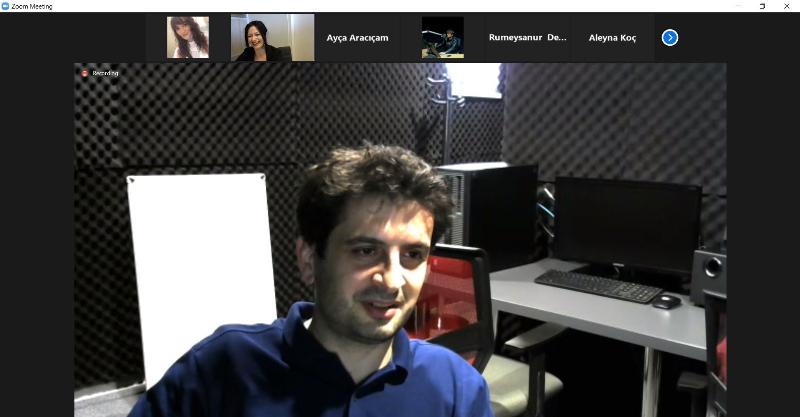
“Ultimately, you need to love the job you do”
Diker stated that loving what you do lies at the core of every job, saying, “I am happy to have graduated from the Faculty of Communication. After graduation, I thought I would work in the industry first and then move into academia. I imagined the industry waiting for me with open arms, but unfortunately, the situation is not like that in our country. Even someone who didn't graduate from the Advertising Department can sometimes do that job. You need to prepare yourself for the worst-case scenario. Whether it's a job, opening a cafe, or something else. Ultimately, whatever you do, you need to love that job. That's the essence of it. 'Would I get bored even if I did this profession 40 years later?', 'Can I endure it?' If your answer is 'Yes' when you ask yourself these questions, then the path will already be easy for you, and you'll be able to face challenges. But if your answer is 'No', then you'll have to grit your teeth. Perhaps you might look for new endeavors.”
“Foreign Language is Very Important in Academia”
Emphasizing the importance of foreign languages for students aiming to become academics, Diker said; “It is highly unlikely for you to become a research assistant or an academic without a foreign language, especially English. A second language must definitely be at an advanced level. You can turn the pandemic into an opportunity; there are many videos you can watch on YouTube. Using these opportunities correctly is very important. I also recommend taking the ALES exam to not miss out on opportunities. It is essential to take foreign language exams like YDS by your third year of university at the latest, just to test yourself. High scores are required for each of these exams.”
“Don't Forget That Even the Most Mundane Topic Has Academic Value!”
Emphasizing the importance of effective and correct use of creativity, Diker said; “For academic qualification, I recommend writing a thesis in the practical exam. You need to learn the format with a professor: 'Why am I citing?', 'How is citation done?', 'Why is it done?' You need to learn and know these. There shouldn't be too many quoted words. It is also necessary to effectively use the element called academic creativity. You can blend information from sociology, psychology, and new media to complete your sentences. You can cite your topic from many fields that would not easily come to anyone's mind and also increase your creativity. Don't forget that even the most ordinary, most mundane topic has academic value.”
“Difficult and Boring Topics Develop You, Enabling You to Make Progress”
Diker stated that everything is quickly consumed today and its validity doesn't last long; “In academia, you need to abstract yourself in some subjects and delve deeper. If your friends are going out for coffee, sightseeing, and invite you, it would be wrong to go despite having work to do. You shouldn't get too accustomed to your comfort zone. A thesis is a very difficult thing. Your brain develops and makes progress after something difficult and boring. You must isolate yourself and persist in success; it should be like this in every matter. Giving up by saying 'I failed' is not right; it means you haven't tried hard enough.”
“If You Want to Be an Academic, You Need Plenty of Time”
Underlining that the desired goal will be reached with patience and time, Diker said; “A person who wants to be an academic needs plenty of time. There are many reasons to give up during the process, so it's important to have intense curiosity and passion for research. This is also very effective in the thesis writing process. The minimum completion time for a doctorate is 5 years, perhaps even more. You spend your entire 20s with this process. You obtain your doctoral title by taking the doctoral qualification exam, followed by the thesis proposal exam, jury meetings, approval, and then the thesis defense exam after 3 thesis monitoring sessions. This process doesn't end immediately; you conduct your research on your chosen topic with another country. You write papers, articles, and attend conferences. It is necessary to embrace academic life. Perhaps you will get bored during this process, and many have left saying, 'I wish I hadn't done this job.' Time is valuable; it won't come back. Therefore, if you brave all kinds of difficulties and are determined, you can easily progress in this field, and you will be surrounded by knowledgeable people. You will find elements that make your life high-quality.” He concluded his remarks.

