

In cooperation with the Department of Political Science and International Relations and the Political Psychology Application and Research Center, an event titled “Turkey-Armenia Relations from Past to Present: Opportunities and Obstacles” was organized. The moderation of the event, which featured Prof. Dr. Yıldız Deveci Bozkuş as a speaker, was undertaken by Prof. Dr. Havva Kök Arslan, Head of the Department of Political Science and International Relations (English).
Content
Turkey-Armenia Relations Discussed with the Participation of Prof. Dr. Yıldız Deveci Bozkuş
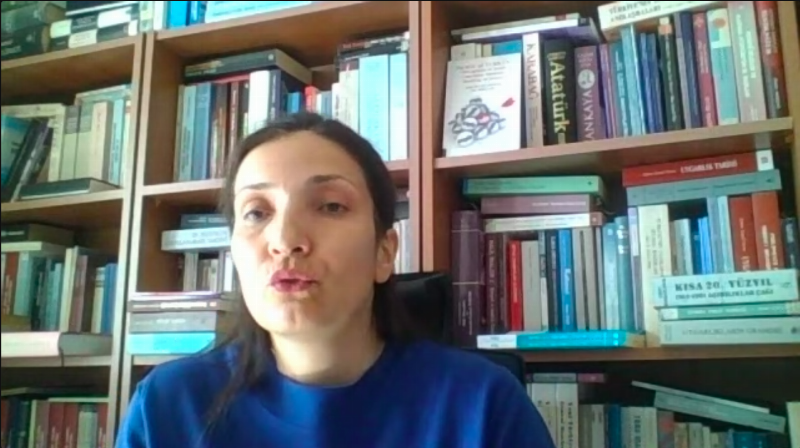
“Turkish-Armenian Relations should not be limited to the 1915 Events”
Bozkuş stated that despite all the suffering and tragedies, Turkish-Armenian relations did not begin in 1915 and should not end with 1915, emphasizing that relations must be freed from the shadow of 1915. Otherwise, future generations will continue to be poisoned by this animosity and hatred for another century, said Bozkuş, noting that there was a climate of tolerance in the Ottoman Empire and this climate should be maintained today.
“Turkey Extended the Hand of Peace to Armenia Many Times”
Bozkuş listed the 2001 TARC Turkish-Armenian Reconciliation Commission, the 2004 VAT Vienna Turkish-Armenian Platform, the Joint Historians' Commission (OTK) established by the Turkish Grand National Assembly in 2005, the football diplomacy in 2008, the Zurich Protocols in 2009, the 2010 World Cup Turkey-Armenia Match, the Cheese Diplomacy in 2012, and Turkey's Six-Party Platform Proposal in 2021 as some of the olive branches extended by Turkey to Armenia. On the other hand, Bozkuş stated that the 1915 Events have not yet been brought to the agenda.
“If Negotiations Continue in a Positive Climate, Diplomatic Relations with Armenia Can Be Established”
Bozkuş emphasized that if lasting peace is achieved between Turkey-Armenia and Azerbaijan-Armenia, borders could be opened, and diplomatic relations with Armenia could be re-established. Bozkuş noted that ongoing normalization talks are currently receiving full support from all parties, including the US, EU countries, and Russia.
“Obstacles to Normalization: Diaspora and Lobbying Activities”
Bozkuş stated that the diaspora is effective in the emergence of Armenian terrorist organizations and their joint actions with other terrorist structures, possesses the power to exert pressure on both the domestic and foreign policies of the countries they reside in, and thus influences Turkey's policies. Furthermore, Bozkuş pointed out that diaspora activities negatively affect Armenia's foreign policy, in addition to their negative impact on the Armenian community abroad. While stating that diaspora activities are the biggest obstacle to the normalization of Turkey-Armenia relations, Bozkuş added that they also increase feelings of animosity and hatred towards Turkey among Armenian generations.
“Normalization Would Be to Everyone's Benefit”
According to Bozkuş, considering the historical ambitions of regional and global powers in this geography, normalization may be the sole solution for regional peace, tranquility, and stability. With normalization, a significant change and transformation can occur in the economic, political, and cultural landscape of the region. Furthermore, Bozkuş stated that the normalization of Turkey-Armenia relations would also have positive effects on Turkey's EU membership process.
The event concluded after the Q&A session.
Share
Update Date: March 01, 2026
Creation Date: June 10, 2022
Request a Call
Other News
- The book that read today's digital threats in 2014: Being a Conscious Family
- Experts warn: 'Instead of memorizing letters, teach pencil grip, scissor use, and coloring'
- School fear and school love both start in the family!
- Family is not merely transforming, it is being battered under a serious assault
- Artificial intelligence opens the door to early diagnosis in autism!