

Üsküdar Üniversitesi Transgenic Cell Technologies and Epigenetics Application and Research Center (TRGENMER) was granted the right to an oral presentation at the 44th COSPAR Scientific Assembly, hosted by the Committee on Space Research (COSPAR) between July 16-24, 2022. TRGENMER, which conducts studies on many hidden, unanswered questions such as 'Which genes and DNAs become active in the body in a zero-gravity environment?', will present these studies.
Content
TRGENMER Invited to the 44th COSPAR Scientific Assembly
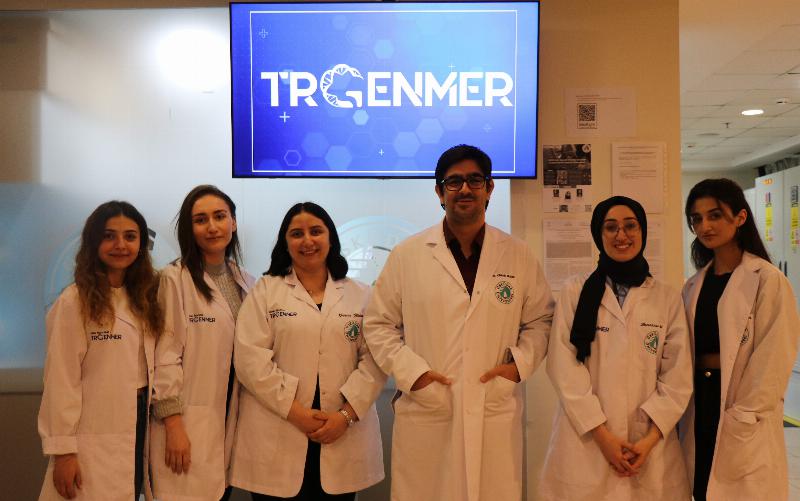
“We submitted our project application representing Turkey and were granted the right to an oral presentation.”
Dr. Cihan Taştan, Director of TRGENMER, will present the project at the conference, which will last approximately 8 days in Athens, Greece. Speaking about the project application process, Taştan provided information about the Committee on Space Research (COSPAR). Dr. Taştan said: “As TRGENMER, our team is conducting studies on the biological hazards that astronauts may face during long stays in space and their solutions. We compiled these studies and applied to the Committee on Space Research (COSPAR), for which the Turkish Space Agency is also a candidate. This committee meets every year, but this year it will gather for the first time in Athens, Greece, for a conference lasting approximately 8 days. As a team conducting astrobiology studies at Üsküdar Üniversitesi, we submitted our project application to this committee, representing Turkey, and were granted the right to an oral presentation. There are almost no other participants from Turkey like us. Especially in the field we call 'Astrobiology', in the category we applied for, there are no other Turks.” he stated.
“There are many hidden, unanswered questions.”
Evaluating the purpose of the project's creation, Taştan said: “With the oral presentation we will make there, we will both be able to network and try to answer many curious, unanswered questions in space studies. Most of these questions are already questions that are only tried to be answered on the International Space Station. Very few places in the world provide such an opportunity. We are trying to be one of them. Because we do not know the answers to many questions such as 'Which genes and DNAs become active in our body in a zero-gravity environment?' There are many such hidden, unanswered questions. We are conducting research with our students that can provide answers to these questions. I will be the only one presenting. My students, two master's and three undergraduate students, are Büşra Tekirdağlı, Ebru Çan, Özge Demir, Berranur Sert, and Gamze Gülden.” he said.
“We will test this technology on some questions that have never been asked before.”
Providing information about what Acoustic Levitation technology is and for what purpose it will be used during the studies, Taştan mentioned the fundamental questions of the project and added: “Before I returned to Turkey, I had a dream for about 7 years. I was applying for a postdoctoral research position at NASA. I have a project idea article from 2015 related to it. In that, I had asked this question: 'People are now starting to live in space. There are astronauts on the International Space Station. These astronauts sometimes need to work there for 1 year or even longer. Moreover, recent technological developments like Elon Musk's SpaceX create the possibility of human colonies on Mars or more distant planets in the coming years. The important thing here is human biology. Is human biology ready for the space environment?' I had asked. Gravity on Earth is not similar to gravity on Mars, the Moon, or other planets. Especially on international space stations, gravity is almost non-existent. We call this 'microgravity'. Of course, since the human body is adapted to Earth's conditions, we don't know how our cells will function in zero-gravity environments, or we know very little about it. To find out, we are trying to support these experiments with studies conducted specifically on international space stations. Studies have been conducted there for many years, but there are very few laboratories and studies in the world that can simulate a zero-gravity environment. Here, we will use the next-generation technology called 'Acoustic Levitation', which NASA has been using for many years. What is this Acoustic Levitation technology? Acoustic Levitation is a machine that specifically creates sonic sound waves between two plates. When these sonic sound waves align with each other, gaps form between them, and you can hold liquid droplets within these gaps. As long as the machine operates, these liquid droplets can remain suspended without falling to the ground. We will test this technology on some questions that have never been asked before. We have applied for funding for this to both our university's BAP program and TÜBİTAK.” he stated.
Share
Update Date: February 28, 2026
Creation Date: April 19, 2022
Request a Call
Other News
- Social responsibility courses moved to the field
- Erasmus+ Orientation Week completed at Üsküdar
- Prof. Nevzat Tarhan: “Brain secretes ‘dark glue’ in social media lynchers!”
- Prof. Nevzat Tarhan: “Every segment of society should be able to say, ‘This constitution is my constitution!’”
- OHS releases guide for safe operation of industrial robots