

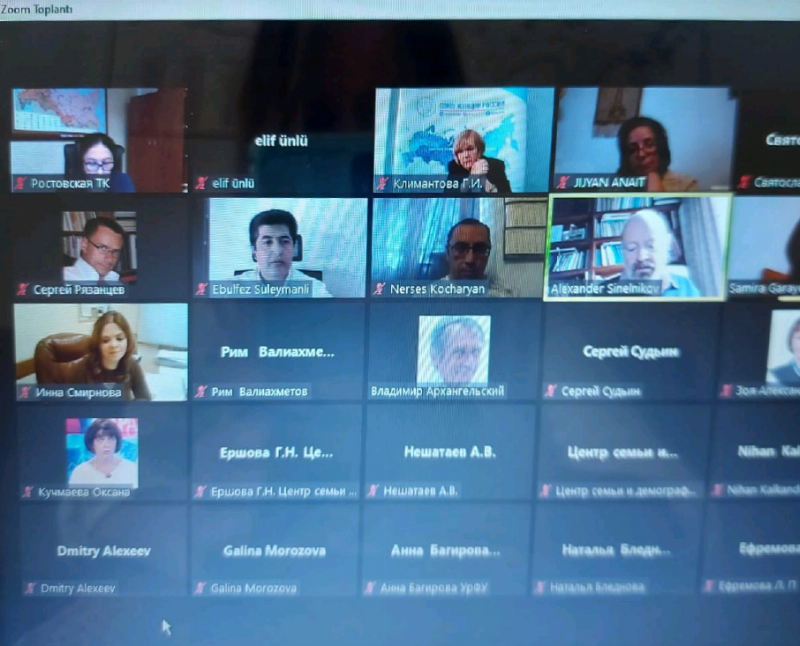
Academics from Üsküdar Üniversitesi Sociology Department participated in the international symposium on “Intergenerational Transmission of Family and Its Tradition”, organized online by the Ministry of Science and Higher Education of the Russian Federation, Ivanovo State University, and the Institute of Demographic Research of the Federal Research Sociological Center of the Russian Academy of Sciences.
Content
Sociology Department Academics Participated in Family Symposium Hosted by Russia
Prof. Dr. Tamara Rostovskaya: “The family institution is one of the elements that ensures the development and maintenance of relationships between generations”
Prof. Dr. Tamara Rostovskaya, Deputy Director of the Institute of Demographic Research of the Federal Research Sociological Center of the Russian Academy of Sciences, delivered the opening speech of the symposium, which was attended by academics working on family from 10 different countries. Prof. Dr. Tamara Rostovskaya stated: “The family institution is one of the elements that ensures the development and maintenance of relationships between generations. From the perspective of family members, there is a system of economic, social, and psychological solidarity.”
Prof. Dr. Ebulfez Süleymanlı: “The parent-authority-focused perspective has given way to a child-centered way of thinking.”
Üsküdar Üniversitesi Sociology Department Head Prof. Dr. Ebulfez Süleymanlı, together with Sociology Department Master's students Elif Ünlü and İrem Zorba, presented a research paper titled “Evaluation of Family in the Context of Helicopter Parenting Profile: The Case of Turkey.” Süleymanlı stated that the concept emerged from adolescent children describing their parents as ‘like helicopters,’ and that research has shown one-third of mothers and one-seventh of fathers in Turkey exhibit helicopter parenting behavior.
Süleymanlı stated that changing economic conditions in today's society have significantly altered parent-child relationships compared to the past, and that the phenomenon of helicopter parenting has become widespread; He added: “The parent-authority-focused perspective prevalent in traditional culture has given way to a child-centered way of thinking.”
Assistant Professor Dr. Nihan Kalkandeler: “To understand the impact of globalization, one should focus on the family and its social position”
Assistant Professor Dr. Nihan Kalkandeler from Üsküdar Üniversitesi Sociology Department delivered a presentation titled “The Changing Structure of the Family in the Process of Globalization and the Feminization of Migration.”
Kalkandeler stated: “The lifestyle envisioned by modernism has been adopted in the global world order, and accelerated social change has increasingly tended to provide more opportunities for individualization. To fully understand the social impacts of globalization, it is necessary to focus on how this process affects the family, which is the basic building block of society, and the family's social position.”
Share
Update Date: March 01, 2026
Creation Date: October 03, 2022
Request a Call
Other News
- The book that read today's digital threats in 2014: Being a Conscious Family
- Experts warn: 'Instead of memorizing letters, teach pencil grip, scissor use, and coloring'
- School fear and school love both start in the family!
- Family is not merely transforming, it is being battered under a serious assault
- Artificial intelligence opens the door to early diagnosis in autism!