

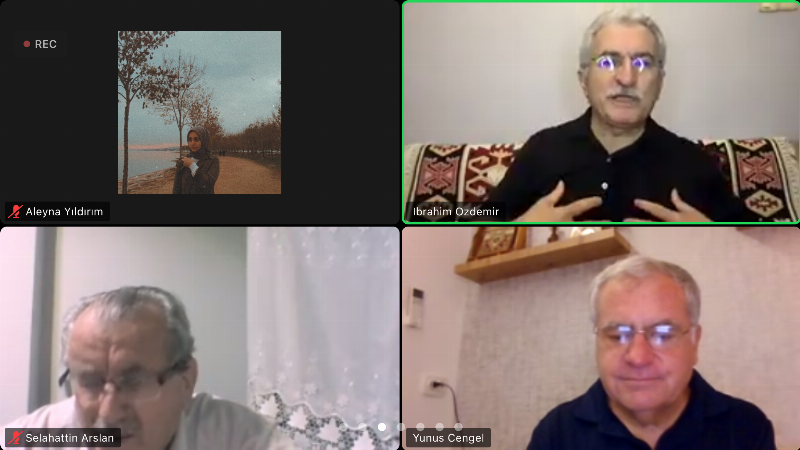
This month's guest of the monthly talks organized by the Risale-i Nur Research Platform (RİNAP) was Üsküdar Üniversitesi Board of Trustees Member Prof. Dr. Yunus Çengel. In the program moderated by Prof. Dr. İbrahim Özdemir, Çengel made important evaluations on the topic of “Brain, consciousness, and mind.”
Content
Prof. Dr. Yunus Çengel: “Our brain is at the center of change and development”
“The brain is the source of consciousness”
Speaking first about consciousness in the program, Prof. Dr. Çengel said; “We are conscious beings and we possess a brain. We have will, we have feelings, we have five senses. We have a myriad of such characteristics. These are generally known as a manifestation of the brain. For example, consciousness is awareness. I am aware of myself, I exist. I am aware that I am speaking right now. Consciousness is awareness in some way. That is, we are not zombies or anything. We know these things. We know that we have consciousness. We feel it in our skull. Then naturally, the brain comes to mind. If we remove the brain, consciousness goes. If we put the brain back, consciousness returns. So it's quite simple. The brain is the source of consciousness. If there is a brain, there is consciousness; if there is no brain, there is no consciousness. The attitude perceived by the five senses, all desires, etc., are all done by the brain.”
“The brain is matter”
Prof. Dr. Çengel, speaking about the structure of the brain, said; “For example, imagine there's a disease in the brain and our eye can't see. Let's say we somehow repair it and immediately start seeing. We automatically understand that the brain sees. When a part of the brain is damaged, we don't see. When it's treated, we start seeing. This means the brain sees. People are naturally conditioned to think this way. When we get to the core of it, the brain is a fatty tissue. It's not much different from a piece of meat or an apple. It has electrical activities, similar to computer processors. The brain neither knows itself, nor what it does, nor anything else. It is a tissue composed of approximately one hundred billion cells and neurons, weighing about one and a half kilograms. Put a few pieces of meat on a table, and next to them, a brain... There isn't much difference. For instance, there are statements like 'the brain commands' etc. The brain cannot do these things, it does not command. The brain is matter.”
“Our brain is at the center of change and development”
Prof. Dr. Çengel stated that what distinguishes us from animals is our potential for development; “The brain is such a thing that it has many parts. Just like in a car, it performs quite a lot of functions by itself. For example, every car has a 'brain' that adjusts things like the air intake in the engine, and we, as drivers, are not aware of it. All of these require will, software, and immense knowledge. It needs to know everything. And there are things within human will, such as learning and understanding, which are not present in these devices. This is what distinguishes humans from animals. Most animals have brains larger than ours. For example, elephants' brains are several times the size of ours, but their brains lack the ability to learn. Our most important characteristic, different from other living beings, is that we come into the world completely ignorant, and by acquiring knowledge, learning, and changing many things, we acquire a brain capable of dominating all animals and everything. Humans are a changing and developing being. Our brain is at the center of change and development. Because, as we use and develop that interface between the body and soul, our memory and our relationships with people and nature become limitless.” he said.
News: Aleyna Yıldırım
Share
Update Date: February 27, 2026
Creation Date: June 25, 2021
Request a Call
Other News
- Üsküdar University participated in an international exhibition with a child rights perspective
- Solidarity Bazaar for Palestine from Üsküdar Residents
- In additional placements, don't just choose a department, choose the profession of the future!
- 52 Erasmus students from 15 different countries at Üsküdar University
- Visit to Prof. Nevzat Tarhan from the Global Confederation of Civil Society Organizations