

Üsküdar Üniversitesi Founding Rector, Psychiatrist Prof. Dr. Nevzat Tarhan participated as a speaker in the International Interdisciplinary Symposium organized by Dicle University. Emphasizing that the 21st century has entered an era of scientific integrity, Tarhan stated that interdisciplinary studies are now becoming widespread. Noting that narcissistic personalities and authoritarian approaches are the biggest enemies of interdisciplinary cooperation, Tarhan added that those who want to conduct interdisciplinary work must adhere to the rules of teamwork.
Content
Prof. Dr. Tarhan: “Narcissists are the biggest enemies of interdisciplinary cooperation”
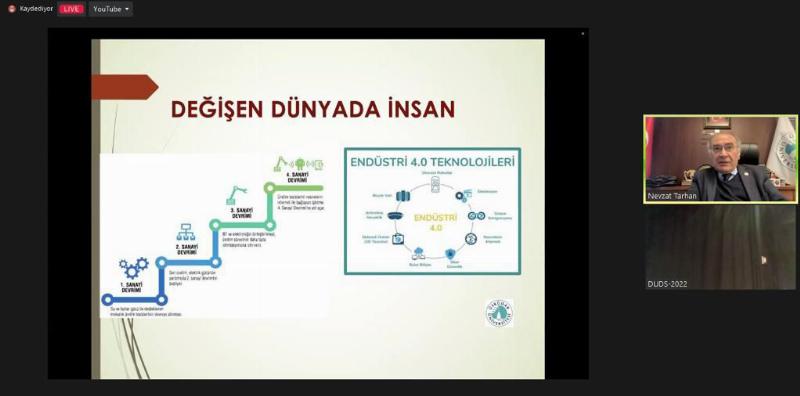
“Whoever dominates big data will secure power and dominance in the world”
Stating that humans must also change with new characteristics in a world transformed by technological developments, Tarhan made evaluations about the 21st-century human. Tarhan said; “In these multidisciplinary studies, I want to implement the necessity, benefits, and risks related to teamwork in the 21st century, the importance of this teamwork, and what kind of contribution interdisciplinary studies will make to humanity, by saying 'human in a changing world'. As you know, Industry 1.0 started in the 1700s and peaked in the 1800s. In Industry 2.0, during the period of machine production, all power, money passed into the hands of those who used steam power. In the 2nd Industrial Revolution, electricity emerged, and with the help of sudden electric power, the Industrial Revolution took place. Here, too, power, money, and dominance passed to those who held them. The Ottoman Empire missed the 1st and 2nd Industrial periods. The 3rd Industrial Revolution also occurred in the 20th century. With the Republic, we joined this 3rd Industrial Revolution. Electronics were discovered. For example, 10 years ago, a Fatih project was carried out, and 2 million computers were distributed. I wish that instead of 2 million computers then, 2 thousand software developers had been trained, and now our own digital platforms would have been established. Therefore, seeing the future and identifying trends is very important. The 4th Industrial Revolution has now started in the 21st century, so why is it important? Because Industry 4.0 technologies emerged: autonomous robots, simulations, cyber internet, cybersecurity, 3D printers, augmented reality, big data artificial intelligence, and the Metaverse. Currently, whoever dominates Big Data will hold power and dominance in the world; this is the direction the world is heading.”
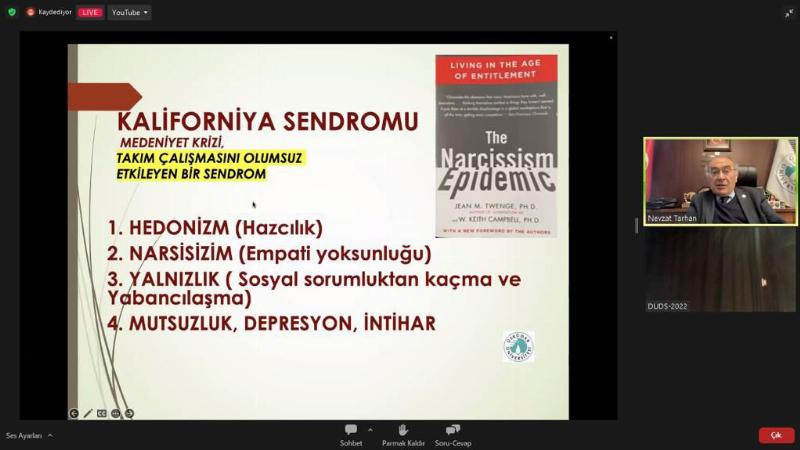
“A global civilization crisis is now being experienced not only in the West but all over the world”
Stating that narcissism is spreading not only in the West but all over the world, Tarhan made striking statements about the civilization crisis. Tarhan said; “Last year, a book about narcissism came out, it talks about the Narcissism Epidemic. Narcissism means being self-centered and lacking empathy. Egoism is a personality trait, but narcissism is a personality structure. This is called the California Syndrome; the world is currently experiencing a civilization crisis. This syndrome is the biggest obstacle to teamwork in the world. Someone caught by this syndrome becomes lonely and unhappy. The person says, 'My interest is ahead of everyone else's, it's a priority.' Narcissism, here too, says 'I am important, special, and superior,' and in such situations, they see everything as their right, their sense of entitlement is self-directed, and a personality type emerges that never feels uncomfortable doing injustice or tormenting others. This is the fate of narcissistic people; as a result, they become lonely and alienated, leading to social isolation. Consequently, unhappiness, depression, and suicide emerge. This syndrome took its name from California because it is concentrated there. I used to call it the Western civilization crisis; now it has become a global crisis. All of these have shown the importance of interdisciplinary work and the socialization we do unconsciously.”
“Eighty percent of life success and academic success is communicating with people”
Tarhan stated that life success is achieved through correct communication with people; “Leader, manager – these are different things. The first rule here is self-management; we will manage ourselves first, before anyone else. We will manage our perceptions and emotions, and correctly manage the benevolent and malevolent parts within us. We will define the benevolent part, then the malevolent part, and then develop self-awareness and self-consciousness. There will be self-management, and then we will develop social relationships. We will empathize with and get to know society and people, and then we will manage relationships; these are indicators of emotional intelligence. The second rule here is that twenty percent of a manager's role is theoretical science, and eighty percent is communication – that is, communicating with people is actually eighty percent of success, eighty percent of life success and academic success. You can achieve twenty percent by reading books and watching videos, but eighty percent of management knowledge within theoretical knowledge is communication, emotional transfer. Tone of voice, perception, emphasis, facial expressions, micro-expressions, and gestures are all our ability to influence the other party, and the most important rule in teamwork is the third rule: convincing people to act and work similarly towards a common goal. That is, instead of trying to change everyone, set a common goal and say, 'remain as you are, try to work and act similarly.' If you succeed in this, interdisciplinary work will be successful. Otherwise, if you tell people 'think like me' and present yourself as disciplined, it will not work.”
“Narcissistic personalities are the biggest enemies of interdisciplinary studies”
Tarhan made statements about 21st-century skills, teamwork, and leadership; “In the 21st century, we entered an era of scientific integrity. Previously, each science was concerned only with its own field. The biggest enemies of interdisciplinary studies are narcissistic personalities. Authoritarian approaches are the biggest enemy of interdisciplinary work, and anger and aggressive behaviors lead to the breakdown of all relationships. Therefore, anyone who wants to do interdisciplinary work must adhere to the rules of teamwork. For this, there is the “Johari Window”. In the Johari Window, there are aspects of ourselves that we know and don't know, and aspects that others know or don't know about us. This is where we and others know our aspects, and here are our blind spots that others know but you and I don't. We all have blind spots in our personality. There is also our own hidden area that we know about our personality but others don't, and something that neither we nor others know. We all have unknown areas, so what should be the proportion of these windows? If the unknown area is large, a different manager emerges; if the hidden area is large, a different personality emerges. These three are problematic personality types; they cannot succeed in human relationships. They cannot overcome the distance like a manager according to rules; success is difficult for them. Such managers do not trust their own thoughts, keep their thoughts secret, and seek information from others, in which case they cannot succeed. This is present in charismatic leaders who manage people through their mistakes and gain success. But later they start making big mistakes; they are among these types of leaders. They also have blind spots; people with many blind spots are authoritarian managers who do not care about their own thoughts but want others to trust them.”
“Man is not just an economic, rational actor; emotions are also important”
Tarhan stated that the most important relationship between leaders and subordinates is trust; “Trust stems from cooperation. First, cooperation will form, then trust will develop over time. A pure and transparent relationship emerges in these individuals: open, pure, and accountable. Management emphasizes information transfer and sharing. Here, in the old model, the capitalist model, humans were considered 'homo economicus'. People were seen as entirely rational beings. This type of personality became the 'homo psychologicus' personality type. Here, considering neuroscience and the metacognitive genes I mentioned earlier, humans will act based on their genes and their brain. Here we have 'homo psychologicus' and 'homo economicus', and therefore, is man a psychological being? Man is not just an economic being, not just rational intellect; a rational actor has emotions. Social intelligence and emotional intelligence are prioritized. For this reason, in corporate loyalty studies, loving the job one does comes first, which is the endowment effect. Feeling safe comes second, and perceived salary comes third. Loving the job one does is much more important than the salary received.”
Share
Update Date: February 26, 2026
Creation Date: November 18, 2022
Request a Call
Other News
- The book that read today's digital threats in 2014: Being a Conscious Family
- Experts warn: 'Instead of memorizing letters, teach pencil grip, scissor use, and coloring'
- School fear and school love both start in the family!
- Family is not merely transforming, it is being battered under a serious assault
- Artificial intelligence opens the door to early diagnosis in autism!