

Üsküdar University Founding Rector Prof. Dr. Nevzat Tarhan and academics from Üsküdar were guests at the "Career Summit in Healthcare." Meeting with candidates planning a career in healthcare, Tarhan made striking evaluations in the session where the future of the psychiatry profession was discussed. Stating that global interest in the healthcare sector will increase with the Covid-19 pandemic, Tarhan added that medicine is an art, that developing artificial intelligence will never be able to diagnose like doctors, and that medicine cannot be taught to machines.
Content
Prof. Dr. Nevzat Tarhan: "Medicine is an art, it cannot be taught to machines!"
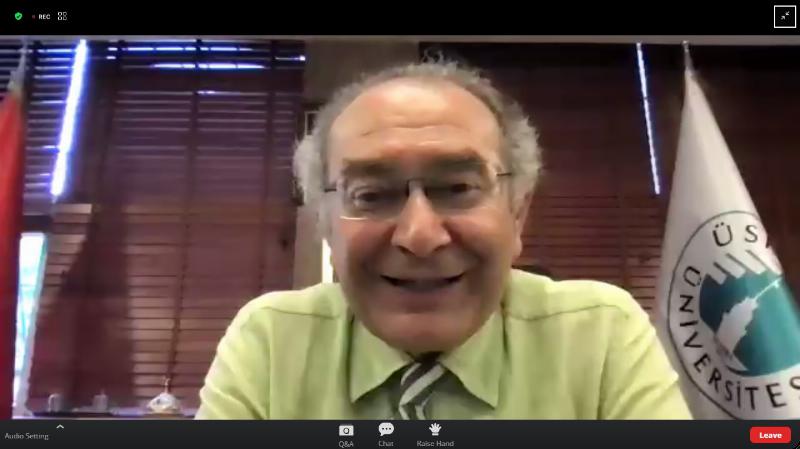
"The future of psychiatry and its process of becoming a science were discussed"
At the summit moderated by Specialist Psychologist and Dietitian Hatice Kübra Işıldar Şentürk, Prof. Dr. Tarhan, who made evaluations on "Psychiatry and its Future," stated that the field of psychiatry is a new branch of science. Tarhan, who stated that the field of psychology should be evaluated holistically with clinical psychology and psychiatry, said; "The future of psychiatry is very closely related to the future of science. The history of psychiatry is quite recent, not exceeding 50 years, because it was previously neuropsychiatry, and then these fields separated. Currently, there are plans to reintegrate them. With the emergence of the unity of sciences in the world, the history of psychology is traced back to Shamanism. However, its transformation into a science is still very new; the history of these fields does not exceed 200 years. In this context, psychology is experiencing a revolution at its core, and it is beneficial for us to evaluate this field, Clinical Psychology and Psychiatry, with a holistic perspective."
"Positive psychology improves psychological resilience"
Tarhan, stating that positive psychology is an important step in the field of preventive mental health work, touched upon the starting point of positive psychology; "With contributions to the literature in the fields of emotion management and emotional intelligence management, these areas have become scientific fields. In the subsequent stage, it gave birth to positive psychology. Positive psychology is generally misunderstood as 'Pollyannaism,' but it is not. While in normal psychology, people see negative as zero, positive psychology raises them above zero, teaching the state they call Well-Being, or psychological resilience. This means that if a person who has experienced depression learns this, they do not fall into depression again. These are the most valuable studies conducted in the field of preventive mental health. When I examined the content of positive psychology, I saw that they systematized it by benefiting from Anatolian wisdom and Eastern philosophy, but without giving references. We are the ones at fault in this regard; in the West, our values were initiated as a branch of science, but we are not aware of this value. Following this, I prepared my works such as Mesnevi Therapy and Yunus Therapy."
"People are no longer concerned with 'how do I get rich,' but rather 'how do I live a higher quality life'"
Tarhan stated that with the Covid-19 pandemic, the 21st century will be the century of wisdom; "The 20th century was the age of information; the 21st century will be the century of wisdom. In the century of wisdom, humanity will no longer be concerned with 'how do I get richer,' but rather 'how do I live a higher quality and happier life.' We can understand this search for meaning as a 21st-century skill. Another 21st-century skill is innovation, entrepreneurship. Unlike other living beings, humans have a gene for seeking novelty. But other living beings do not have a gene for seeking novelty; an ant builds its nest the same way it did 1000 years ago. The reason innovation and entrepreneurship are skills is that if you don't have a goal in mind, you just become an object of the current system; they teach, and you use. But if you want to be the subject of the system, of civilization in the world, if you want to be someone who discovers and creates, if we want to catch up with and go beyond the era, it is important to use this skill."
"Without the frontal lobe, there would be no civilization"
Tarhan, stating that a synthesis of religion and science is taking place in the education system worldwide; "Science and religion are no longer alternatives to each other but have become complementary. Psychiatry is a science very closely related to this field. Psychiatry is a borderline field within medical sciences, related to social sciences, with half in medical sciences and half in social sciences. Achieving this synthesis is easier in psychiatry. What is done in the education system is frontal lobe training, essentially training the forebrain. Without the frontal lobe, there would be no civilization; it is the frontal lobe that makes humans human. Other living beings besides humans are born having learned about the world; a duck hatches from an egg and immediately swims, there's no need for it to learn how to swim. But a human child is born to learn, psychologically premature. Therefore, humans learn everything through social learning. Humans even learn their identity later."
"Globally, demands related to health will increase"
Tarhan stated that those who choose healthcare as a profession after the pandemic are lucky; "After the Covid-19 pandemic, the value of health and healthcare professionals was understood, and healthcare as a profession is a much more preferred field today. I foresee that global demands related to health will increase because people want to live a higher quality life. Wanting to live a higher quality life, wanting to live a humane life, is a fundamental human right. The most important of these is living healthy. In the healthcare system, there is much work to be done in every field, from associate's degrees to master's and doctoral degrees. Anyone open to self-development and innovation learns continuously. If you want to work in healthcare, you need to be open to new experiences. If you are open to new experiences, you can succeed and advance in the healthcare field. A person who loves helping people becomes very successful when they become a healthcare professional."
"Medicine is an art, artificial intelligence cannot diagnose"
Tarhan, drawing attention to fears that medicine will change with artificial intelligence, stated that medicine will maintain its position and that only diagnosis might become easier with artificial intelligence. Tarhan emphasized that recommending medication is the doctor's responsibility; "Ultimately, medicines are chemical weapons. If used appropriately and on time, they provide benefits. The medicine with the fewest side effects is the one not taken. Therefore, it is necessary to be very careful with medication. Treatment in psychiatry falls under personalized medicine. Knowing a person's genetic profile when administering medication is particularly important for cases resistant to treatment. The e-Nabız system, which enables us to know genetic profiles, has been very useful in this regard. The ministry that best adapts to digitalization is the Ministry of Health. Just as artificial intelligence affects every field, it will also transform the healthcare sector. By utilizing the information provided by artificial intelligence, doctors will make decisions more easily. However, artificial intelligence can never make a diagnosis because medicine is not just science. Medicine, healthcare, is also an art; this skill cannot be taught to machines. However, artificial intelligence will also make the doctor's job easier, provide advantages in many areas, and make reporting simpler. In terms of career choice, individuals inclined towards digitalization will be more successful in the healthcare field. Therefore, in the healthcare field, as in all fields, it is necessary to think in the medium and long term and to have a vision."
"When people do what they love, emotions and the brain get involved"
Tarhan emphasized that everyone should do what they love and are happy with, stating that one must be a good person before becoming a good professional. Tarhan said; "When they ask me how to become a good doctor, I always say, 'First, be a good person. Without being a good person, you cannot be a good doctor, nor a good psychologist. If you want to be a healthcare professional, first be a good person. If you love helping people, this profession is suitable for you.'" Tarhan, stating that some people do not enjoy helping others; "Then please do not choose healthcare; turn to other fields. Because this field is deeply intertwined with people. A person who does work they love is not truly 'working.' This is called the feeling of flow. This is not work. So, people should either work at what they love or learn to love their current job. This is the most important condition for success. Because if a person puts their emotions into the work they do, the whole brain assists them. If they do not add emotions, only a thinking brain operates, but for a person to engage their feeling brain, they must certainly incorporate their emotions into the work they do. The most important advice I would give to those considering medicine or the healthcare field is that they need to be open to new experiences. In quality management, the most important thing is vision. Vision is a person thinking about what they can become. Mission is thinking about what they can do. To be able to imagine what can be and what can be done, to use one's imagination towards a goal, is a twenty-first-century skill."
Furthermore, speaking at the session where the medical profession was introduced at the Career Summit in Healthcare, Prof. Dr. Haydar Sur, Dean of Üsküdar University Faculty of Medicine, explained the skills that those working in medicine should possess; "These skills are three: clinical knowledge and skill, communication skill, and governance skill."
In the session held regarding the Speech and Language Therapy profession, Assist. Prof. Dr. Mehmet Emrah Cangi, Assistant Head of the Speech and Language Therapy Department from Üsküdar University, participated as a speaker.
In the day's final session, Prof. Dr. Nurper Ülküer, Head of the Child Development Department at Üsküdar University, participated in the child development department introduction event. Ülküer said; "The child development profession is among the rising values, and investment in this profession is needed."
Share
Update Date: February 27, 2026
Creation Date: July 08, 2021
Request a Call
Other News
- Prof. Nevzat Tarhan: “Those with a mental filter are not afraid of the digital”
- Artificial intelligence doesn't eliminate the translator, it transforms their expertise!
- Social responsibility courses moved to the field
- Erasmus+ Orientation Week completed at Üsküdar
- Prof. Nevzat Tarhan: “Brain secretes ‘dark glue’ in social media lynchers!”