

Üsküdar Üniversitesi Founding Rector Prof. Dr. Nevzat Tarhan, was a guest at the program organized by the Konya Provincial Directorate of National Education. Tarhan made evaluations under the title “New Truths in Education and 21st Century Skills.” Emphasizing that Generation Z is an inquisitive generation, Tarhan said; “Generation Z is the generation that will save our future. I am not pessimistic at all about Generation Z. I work at the university and I see young people. There are questioning young people now. None of them are children of the culture of obedience, saying ‘Yes, sir.’” he said.
Content
Prof. Dr. Nevzat Tarhan: “Generation Z Will Save Our Future”
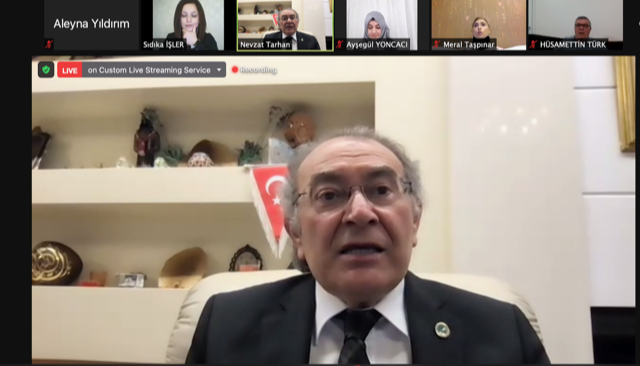
“Covid-19, a global trauma with potential impact”
At the beginning of his speech, Tarhan emphasized the importance of strengthening weak links; “Covid-19 seems to be ending one era and starting another. Covid is a global trauma with potential impact. We now call it the Covid tragedy, not the Covid pandemic. It's such a tragedy that it can be for human benefit or harm... It depends on the position we take.
There are expensive watches but no time at all. Bigger television, fewer books. More people, less humanity. More friends on social media, zero real friends. More suspicion, less trust. More discrimination, less empathy. More material prosperity, less spiritual peace. Covid arrived at such a time. Life is like a chain; the strongest link of the chain is its weakest link. It is that strong. When there is a crisis, it breaks there. If the economy is bad in a society, it breaks there; if family life is bad, it breaks there; if social life is bad, it breaks there. Breakages occur where things are worn out. Accordingly, we must approach events by considering that the breaks in every society will be justified. What is the weak link in our society? Strengthening that link is important. If we know it, we strengthen it. We will emerge from the crisis with less damage. For this reason, we first need to discuss our industrial resume, the industrial story, and the story of humanity's industrialization and industrialization in the Ottoman Empire and Turkey.” he said.
“Generation Z will save our future”
Tarhan, speaking about the new generation questioning everything; “After the 2000s, a serious digital transformation took place. Power, money, and dominance fall into the hands of those who catch this transformation. But this transformation has a feature. When this transformation combines high computer technology, super computer technology, and super young people, super things can be done. We now have super young people. Some exclude and underestimate Generation Z. Generation Z is the generation that will save our future. I am not pessimistic at all about Generation Z. I work at the university and I see young people. They are now questioning young people. None of them are children of the culture of obedience, saying ‘Yes, sir.’ These are now young people who question everything, hold accountable, and think freely. A mass that does not question, thinking ‘the state knows everything,’ emerges, but this generation is not like that; they question.” he stated.
“The stronger your database, the stronger you are”
Tarhan, speaking about neuroscience-based learning; “When it comes to neuroscience-based learning, the year 2004 comes to my mind. At that time, Ziya Selçuk was the head of the Board of Education. A symposium was held under the title ‘Quest for New Reforms in Education.’ It became a book. I made this presentation there with the information available at that time. Currently, there are new truths brought by neuroscience in education. We need to give new answers to old questions with these new truths. If we don’t provide these answers, we will miss everything. However, for unknown reasons, our education system could not develop education and cultural policies. Now, some steps are being taken, such as project lists and design workshops. For example, if these steps had been taken back then, we would perhaps be like South Korea now, 15 years later. We would be technology exporters, not technology importers. Because South Korea and China invest 10 percent in R&D. The stronger your database, the stronger you are.” he noted.
Share
Update Date: February 27, 2026
Creation Date: May 25, 2021
Request a Call
Other News
- The book that read today's digital threats in 2014: Being a Conscious Family
- Experts warn: 'Instead of memorizing letters, teach pencil grip, scissor use, and coloring'
- School fear and school love both start in the family!
- Family is not merely transforming, it is being battered under a serious assault
- Artificial intelligence opens the door to early diagnosis in autism!