

Turkish Physician, Psychiatrist and Neuropsychologist, Founder Rector of Üsküdar Üniversitesi Prof. Dr. Nevzat Tarhan gave an interview to Riskli Magazine.
Content
Prof. Dr. Nevzat Tarhan; "Advancing in life is a risk, but calculating your risks is in your hands"
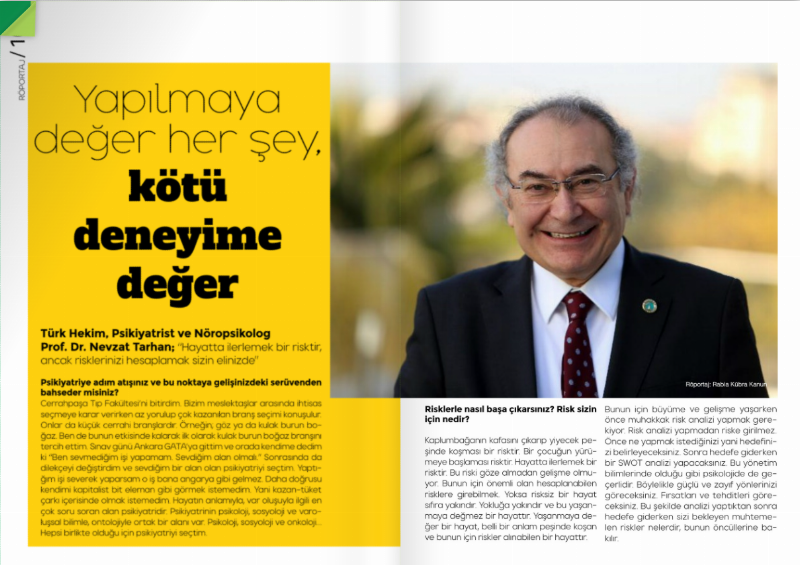
Could you tell us about your journey into psychiatry and how you reached this point?
I graduated from Cerrahpaşa Faculty of Medicine. Among my colleagues, when deciding on a specialization, there's talk about choosing a field where you tire less and earn more. These are minor surgical branches. For example; ophthalmology or ENT. Influenced by this, I initially preferred ENT. On the day of the exam, I went to Ankara GATA and told myself, 'I can't do a job I don't love. It has to be a field I love.' Afterwards, I changed my application and chose psychiatry, a field I love. If I do the work I love, it doesn't feel like a chore. More precisely, I didn't want to see myself as a capitalist cog. I didn't want to be in a earn-and-spend cycle. Psychiatry is the field that asks the most questions about the meaning of life and existence. Psychiatry has a common ground with psychology, sociology, and existential science, ontology. Psychology, sociology, and oncology… I chose psychiatry because it encompasses all of these.
How do you cope with risks? What does risk mean to you?
For a turtle to stick its head out and search for food is a risk. For a child to start walking is a risk. Advancing in life is a risk. Without taking this risk, there is no progress. What's important is to be able to take calculated risks. Otherwise, a risk-free life is close to zero. It's close to non-existence and is a life not worth living. A life worth living is one that pursues a certain meaning and can take risks for it. For this, when experiencing growth and development, it is absolutely necessary to first conduct a risk analysis. One should not take risks without performing a risk analysis. First, you will determine what you want to do, that is, your goal. Then, you will perform a SWOT analysis while heading towards your goal. This is valid in psychology as it is in management sciences. Thus, you will see your strengths and weaknesses. You will see opportunities and threats. After performing the analysis in this way, you look at the precursors of the probable risks that await you when moving towards your goal.
When embarking on a journey in winter, you choose clothes and shoes accordingly, meaning you take precautions. When going to war, you take your shields. You need to set the goal and take precautions before setting out. This is a preliminary analysis. The second is a needs analysis. You will perform a needs analysis and accordingly determine what the precursors are against potential dangers. You will not forget the strategic goal, but you will also make arrangements accordingly from time to time. At the same time, resource management is important in risk analysis. You will allocate your resources according to risky areas. Imagine a war, the commander moved the battalion to a location. Everyone wants to rest as soon as possible, but the commander looks around to see where an enemy or terrorist might attack from and places sentries there. First, he takes precautions, then he rests. The important thing is not to give up on the task after identifying the risks and taking precautions. The biggest fear in the way of development is the fear of change. The biggest fear in the way of growth, innovation, and entrepreneurship is the fear of change. Many people live to maintain the status quo. This must change.
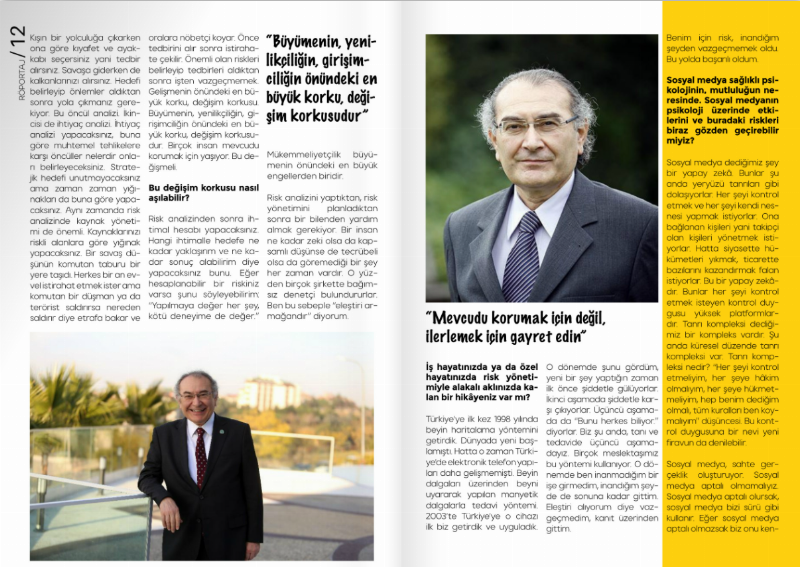
How can this fear of change be overcome?
After risk analysis, you will calculate probabilities. You will do this to determine how close you can get to the goal and how many results you can achieve with what probability. If you have a calculable risk, I can tell you this: “Everything worth doing is worth a bad experience."
"The biggest fear in the way of growth, innovation, and entrepreneurship is the fear of change"
Perfectionism is one of the biggest obstacles to growth.
After performing risk analysis and planning risk management, it is necessary to seek help from an expert. No matter how intelligent, comprehensive in thought, or experienced a person may be, there is always something they cannot see. That's why many companies employ independent auditors. For this reason, I say, "criticism is a gift."
Strive to advance, not to maintain the status quo
Do you have a memorable story related to risk management in your business or private life?
We introduced the brain mapping method to Turkey for the first time in 1998. It had just begun globally. Even then, electronic telephony was not yet developed in Turkey. We were the first to bring and apply the treatment method using magnetic waves to stimulate the brain via brain waves to Turkey in 2003.
At that time, I observed that when you do something new, first they laugh heartily, in the second stage, they vehemently oppose it. In the third stage, they say, "Everyone knows this." We are currently in the third stage of diagnosis and treatment. Many of our colleagues use this method. At that time, I didn't get involved in something I didn't believe in, and I went all the way with what I did believe in. I didn't give up because I received criticism; I proceeded based on evidence.
For me, the risk was not giving up on what I believed in. I succeeded on this path.
Where does social media stand in relation to healthy psychology and happiness? Can we examine the effects of social media on psychology and the risks involved?
What we call social media is an artificial intelligence. They currently roam like gods on earth. They want to control everything and make everything their object. They want to manage the people connected to them, i.e., their followers. They even want to overthrow governments in politics, and make some people win in trade, and so on. This is an artificial intelligence. These are platforms with a high sense of control that want to control everything. There is a complex we call the 'God complex'. Currently, there is a God complex in the global order. What is the God complex? The idea of 'I must control everything, I must dominate everything, I must rule everything, it must always be my way, I must set all the rules.' This sense of control can also be called a new pharaoh, in a way.
Social media creates false realities. We should not be social media fools. If we are social media fools, social media uses us like a herd. If we are not social media fools, we use it for our own purposes. We must be the subject, not the object, of social media. Since such a platform exists, we need to ask how we can use it for the benefit of people.
Google has established a persuasion laboratory. In the persuasion laboratory, they use artificial intelligence to find the keywords you like. If you don't say no to this, you'll suddenly find hours have passed. We need to learn to say no to it. We need to acquire the skill to say no to social media. We need to teach our children the skill to say no to social media. If we determine our own importance and priorities, we will not be victims of social media.
People assume different roles depending on their environment. So, how should people manage these roles to be happy in both their private and professional lives?
We have a scale related to parenting styles. This scale has five sub-dimensions, one of which is role sharing. Can the father separate his businessman role from his husband role and father role? Can the mother distinguish her businesswoman role from her wife role and housewife role?
Even if women work, the mother role takes precedence over the father role in our society. The housewife role becomes more prominent. Women tend to have double careers compared to men and therefore wear out more.
"For a turtle to stick its head out and search for food is a risk, but it is necessary for survival"
If both partners work, household responsibilities will change. That is, the man will help his wife, and the woman will help her husband. If this is done at the beginning of the marriage, it proceeds easily afterwards. But because the woman, with her maternal instinct and strong sacrificial pattern, always gives from herself and acts selflessly, saying 'let there be no problems, my family is more important'. The man gets accustomed to the reign, having established a throne. After the children grow up and leave, when the woman says, "Let's spend some time together," the man doesn't want to leave his old comfort. This is the biggest reason for arguments and divorces after the age of 50. Therefore, it needs to be prepared from the very beginning. If this is prepared, then from the beginning, sharing life together becomes essential. In our culture, marriage partners were not called simply 'eş' (spouse). They were called 'refik' and 'refika'. Refik means male travel companion, and refika means female travel companion. So, there's a marriage ship heading towards a goal. There you will raise good children, meet their basic needs, and prepare them for life. The goal is not to look into each other's eyes. It is to walk together towards a goal, to advance. If that's the case, there are no ego wars in relationships. Role sharing becomes healthier. If there is no role sharing, there are boundary violations and conflicts in the relationship. Clarifying boundaries makes the relationship healthier. A healthy child takes three things as an example: the mother, the father, and the relationship between the mother and father. If the mother and father's relationship is healthy, the child also grows up healthy. The greatest product and output of a home is raising good children. This is no less important than establishing a good factory... Managing 500 people, that's a good thing. Raising a good child, beneficial to society and the country, is no less important than that. Therefore, a person who can manage time wisely without neglecting to raise good children can easily do both simultaneously.
Share
Update Date: February 28, 2026
Creation Date: December 16, 2021
Request a Call
Other News
- Social responsibility courses moved to the field
- Erasmus+ Orientation Week completed at Üsküdar
- Prof. Nevzat Tarhan: “Brain secretes ‘dark glue’ in social media lynchers!”
- Prof. Nevzat Tarhan: “Every segment of society should be able to say, ‘This constitution is my constitution!’”
- OHS releases guide for safe operation of industrial robots