

An online event was organized by Üsküdar University Vocational School of Health Services on the topic of 'The Use and Importance of Oleuropein and Hydroxytyrosol Obtained from Olive Leaves in Foods'. Dr. Salih Tuncay, Assistant Director of Üsküdar University Vocational School of Health Services and Head of the Food Technology Program, participated as a speaker in the event, which was held as part of the University Culture course. Starting his presentation by providing information on what Oleuropein and Hydroxytyrosol are, Tuncay spoke about the application areas of the components.
Content
The health benefits of olives and olive products were discussed…
“The olive tree is the first tree that generously repaid mankind for its labor on Mount Tabor”
Dr. Salih Tuncay, speaking about the emergence of the olive tree in mythology, said; “There are two kinds of trees in Paradise. One is the fig tree, and the other is the olive tree. After eating the forbidden fruit, Prophet Adam, sent from Paradise to Earth with Eve, feeling that he would die, decided to ask God to forgive him and, by extension, all humanity. For this purpose, he sent his son Seth to the Garden of Paradise. The angel guarding the garden gave Seth three seeds taken from the Tree of Good and Evil (Tree of Knowledge) and told him to place these three seeds in his father Adam's mouth when he died and bury him. Prophet Adam died shortly thereafter and was buried in the Hebron Valley, near a mountain located in the north of Israel, in the land formerly known as Galilee, near Mount Tabor. After his burial, three trees sprouted from the earth: olive, cedar, and cypress trees… Among the three trees, symbols of the Mediterranean climate, the first to sprout was the olive tree. The olive tree is the first tree that generously repaid mankind for its labor on Mount Tabor. Peace between God and man was thus established. Although the cultivation and care of the olive tree are quite difficult, with the story told behind it, it has been made part of another work,” he stated.
“Olives and olive products, with their high phenolic content, hold a very important place for human health”
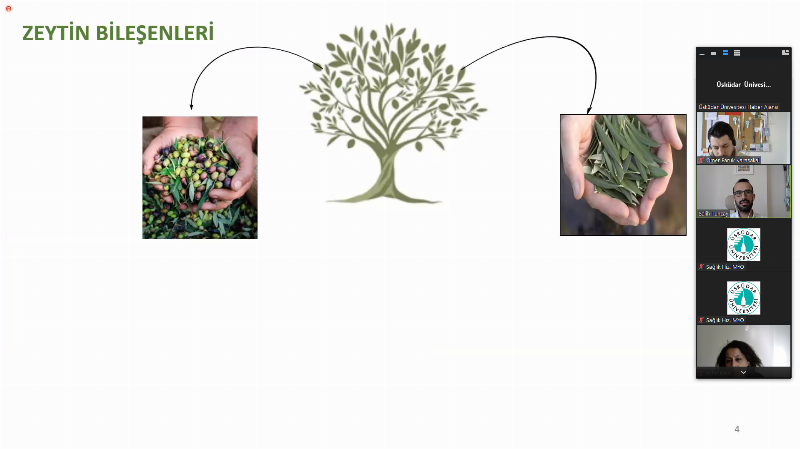
Dr. Salih Tuncay, emphasizing the importance of olive trees for human health, said; “For Turkey, one of the richest countries in the world in terms of olive tree count, the olive sector holds great importance for both agriculture and industry. Olives and olive products, prominent in the Mediterranean diet and rich in phenolic compounds, hold a very important place for human health. According to one theory, the homeland of the olive tree is Syria,” he added.
“The Oleuropein compound has a protective effect against diseases and harmful agents”
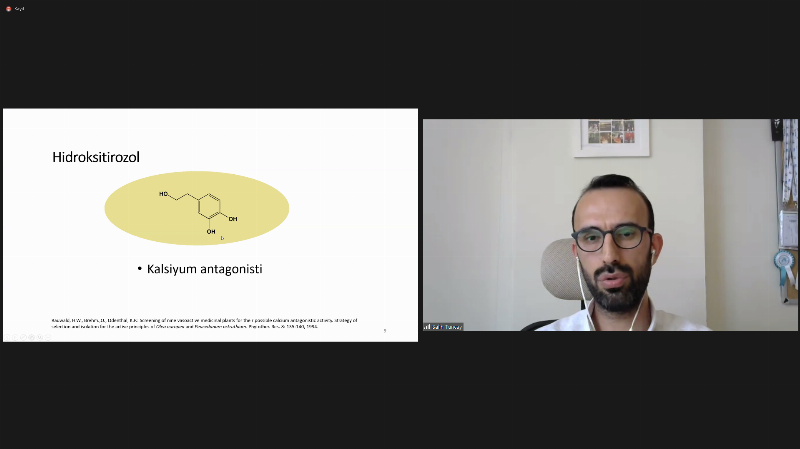
Dr. Salih Tuncay provided participants with information on what Oleuropein and Hydroxytyrosol compounds are, explaining their connection to the olive tree with examples. Tuncay said; “The Oleuropein compound, found more abundantly in olive leaves, has a protective effect against diseases and harmful agents. Oleuropein, which also plays a very important role in the resilience of the olive tree, is also responsible for the bitter taste of olive fruits. However, beyond these, there are different molecular classes found in olive leaves. Oleuropein and Hydroxytyrosol compounds are the two most abundant substances among them. Oleuropein and Hydroxytyrosol, fundamental phenolic compounds of the olive tree, are found in most of the nutritional and organoleptic properties of olive oil and olive fruit. For example, if 20 grams of olive oil contains at least 5 mg of Hydroxytyrosol, it means it can be used for therapeutic purposes in heart conditions. Oleuropein, on the other hand, is hypotensive. That is, it is a structure that lowers high blood pressure or reduces higher blood pressure by causing vasodilation,” he stated.
Share
Update Date: February 28, 2026
Creation Date: April 14, 2022
Request a Call
Other News
- The book that read today's digital threats in 2014: Being a Conscious Family
- Experts warn: 'Instead of memorizing letters, teach pencil grip, scissor use, and coloring'
- School fear and school love both start in the family!
- Family is not merely transforming, it is being battered under a serious assault
- Artificial intelligence opens the door to early diagnosis in autism!