

The Fi-gital Future Summit 2021 is being organized in cooperation with the Istanbul Provincial Directorate of National Education and Üsküdar University. Speaking at the opening panel of the summit, Prof. Dr. Nevzat Tarhan, Founding Rector of Üsküdar University, emphasized that everyone should now see digitalization as a necessity, a responsibility brought by the times. Prof. Dr. Tarhan stated, 'Digitalization is the spirit of the age and the reality brought by this era. We need to embrace this reality like the wind at our backs, not against us, and move towards our goal. We believe this is important as fi-gitalization. It should not just be digitalization, but a synthesis of physical and digital. This is also important in terms of social and emotional skills.'
Content
Fi-gital Future Summit Has Started
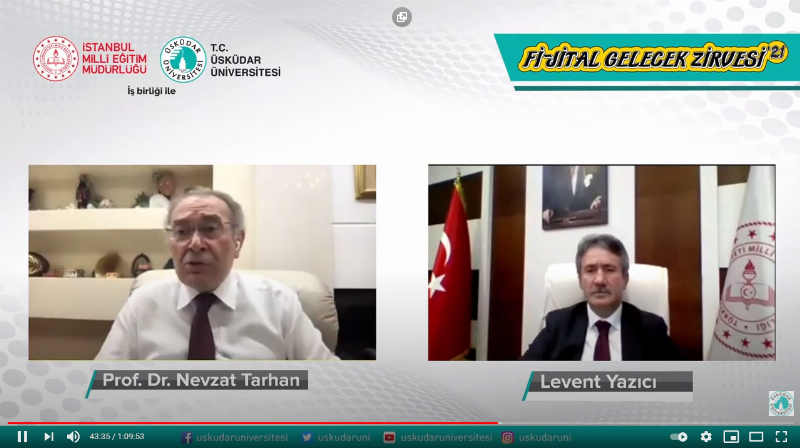
Prof. Dr. Nevzat Tarhan: “Digitalization is the spirit of this age and the reality it brings”
Istanbul Provincial Director of National Education Levent Yazıcı also stated that important lessons should be learned from the pandemic, noting that students, teachers, and parents gained significant benefits from the digitalization experienced during the pandemic. In the summit, which will be held online until June 11, Prof. Dr. Sevil Atasoy, Prof. Dr. Sinan Canan, Prof. Dr. Acar Baltaş, and Prof. Dr. Deniz Ülke Arıboğan will meet with young people and discuss topics related to the digital future.
The “Fi-gital Future Summit 2021” is being organized between June 7-11, 2021, in cooperation with the Istanbul Provincial Directorate of National Education and Üsküdar University. The summit, held online due to the pandemic, began with a panel moderated by journalist Şaban Özdemir, attended by Istanbul Provincial Director of National Education Levent Yazıcı and Üsküdar University Founding Rector, Psychiatrist Prof. Dr. Nevzat Tarhan.
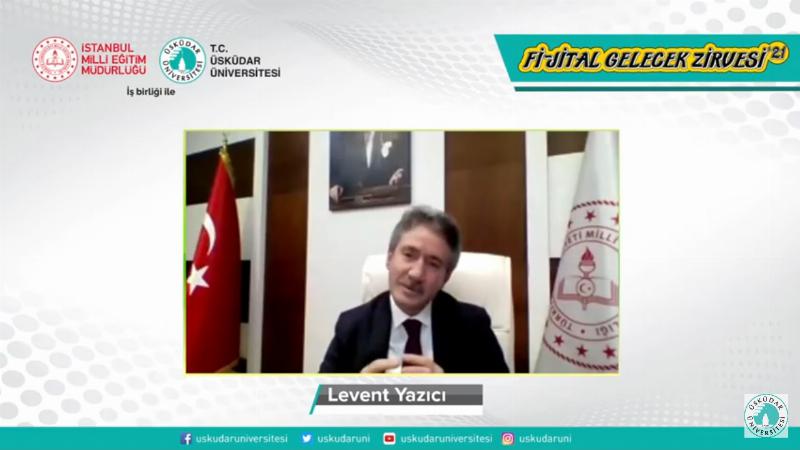
Levent Yazıcı: “The Fi-gital Future Summit will provide important contributions”
Istanbul Provincial Director of National Education Levent Yazıcı stated that they are carrying out multi-faceted studies with Üsküdar University in line with the institutional cooperation understanding envisioned by the 2023 education vision, adding, “In this context, the Fi-gital Future Summit will make an important contribution to thinking about educational environments and future learning environments.” Yazıcı noted that with the transition to distance education, the learning dimension has been significantly affected not only in Turkey but all over the world. He said, “I believe this impact is not academic, as commonly thought, but rather related to emotional and social areas. In other words, it actually contains different dimensions for the versatile development of our students. We assume that academic learning has been affected in many ways, but I think this is more about the child's holistic development and emotional framework.” Levent Yazıcı also noted that in the context of distance education, psychosocial support, as well as technological efforts, have gained significant importance. He added, “In this framework, teachers, students, parents, and all non-governmental organizations that create value regarding these processes are undertaking many tasks in the same context. Of course, we continue to work with the same inclusive and encompassing enthusiasm.” said.
Levent Yazıcı: “The Fi-gitalization Manifesto should be evaluated in a multifaceted way”
Levent Yazıcı stated: “In this context, the fi-gitalization manifesto published by Üsküdar University's management, academics, and administrative staff under the title 'New normals and new answers' needs to be evaluated in a multifaceted way. I especially want to state that the Ministry of National Education carried out truly different studies with certain dimensions that need to be expressed within the questions Üsküdar University sought to answer. In this framework, the Ministry of National Education entered the pandemic process prepared in many aspects. Because from the very beginning of the process, regarding distance education, there is no need to explain all of them one by one, but a few points that coincide with Üsküdar University's fi-gitalization manifesto text need to be emphasized. The issues of digitalization and nationally valid certificates really need to be underlined. As the Ministry of National Education, we witnessed the following scene from the first days of the pandemic: while many countries in Europe and America could not actually start distance education, in our country, the distance education process started very quickly with the existing infrastructure, established corporate collaborations, and the sacrifices of our teachers.”
We once again saw the importance of socialization at school
Levent Yazıcı said, “In this process, we once again saw how vital the gains from school learning, socialization at school, and the maturation process at school, which are achieved or can be achieved by the student being present at school. The foundation of learning must proceed holistically with the student's emotions and thoughts. Only certain competencies do not truly contribute to the multifaceted development of the student. As we always state, perhaps the easiest aspect for us to compensate for is academic deficiencies. But the truly vital issues we need to develop holistically in students will be the development of our student's emotional world, thoughts, social aspects, cultural aspects, and social skills in a comprehensive manner.” said.
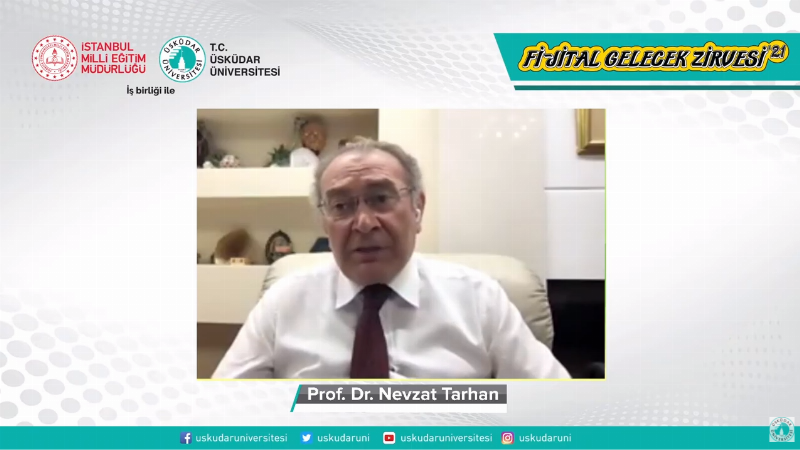
Prof. Dr. Nevzat Tarhan: “One of the 21st Century skills is the principle of a learning organization”
Üsküdar University Founding Rector, Psychiatrist Prof. Dr. Nevzat Tarhan, also stated in his speech at the opening panel that the Fi-gital Future Summit was organized in collaboration with the Istanbul Provincial Directorate of National Education, adding, “The vision of the Istanbul Provincial Directorate of National Education on this issue was very important. They contributed this vision to us, and we prepared with our lecturers and team. A global digital transformation is underway. For example, EBA TV became a very good phenomenon for us. It was understood that EBA TV's education and information system is a very serious phenomenon. In the beginning, there was a shock for a few weeks, which we also experienced, but it quickly recovered.” Tarhan noted that one of the 21st-century skills is the principle of a learning organization, stating, “According to the principle of a learning organization, everyone learns. Teachers learn, students learn, society learns, and lifelong learning takes place.” said.
Prof. Dr. Nevzat Tarhan: “How did digitalization affect our lives?”
Prof. Dr. Nevzat Tarhan noted that digitalization was very urgent, especially in education and health during the pandemic, stating, “In both, our Ministry of National Education and we as a university provided case examples. In education, we had the right to digitalization, granted by law, of up to 30 percent. We had planned to transition to 30 percent beforehand and established our infrastructure. This requires a very serious infrastructure. EBA is actually a very large technological infrastructure. As a university, we have 22 thousand students, and we wondered how to reach them. After 2 weeks, we were able to conduct synchronized live lessons. While many institutions or universities progressed by providing video information and assignments, we delayed the academic calendar by two weeks, started from scratch, and were able to give synchronized lessons. Our lecturers have continued to teach half from home and half from the institution until now. We hope for normalization next month; the light at the end of the tunnel is visible. In such a situation, how has this digitalization affected our lives? I question what the mandatory digitalization brought by Covid has taught us about education. How should we act in our new normal from now on? This applies not only at the institutional level but also to our young people, educators, and families who listen to us.” he said.
Prof. Dr. Nevzat Tarhan: “Anxiety rises when we constantly focus on threats”
Prof. Dr. Nevzat Tarhan stated that there are two aspects to danger in crises: “The first aspect is threat, and the second is opportunity. When we constantly focus on threats, we see that people's anxiety has increased, and they continuously follow infectious disease specialists. When watching infectious disease specialists, threat-focused anxiety rises, and as anxiety rises, post-pandemic psychiatric problems began to increase. There is a threat, but within every threat, there is also an opportunity and a gain. When there was mandatory lockdown at home, when there was isolation, or when we were with our children, we tried to make them think about how to direct and shape it towards something better and more beautiful in their lives.” said.
Prof. Dr. Nevzat Tarhan: “Distance learning is possible, but not distance education”
Prof. Dr. Nevzat Tarhan noted that after the first wave of the pandemic last year, they held a full-day brainstorming session with the participation of academics at the university during the summer, stating, “We held a serious vision meeting with 100 academics and senior management. As a result, we wanted to publish such a manifesto. Learning can be done remotely, but education cannot be done remotely. That's why we wanted to make it fi-gital. However, there were difficulties with fi-gitalization, but now, at least, it can proceed with some compensations.” said.
Prof. Dr. Nevzat Tarhan: “Societal psychology does not function differently from that of individuals”
Prof. Dr. Nevzat Tarhan reminded that parents asked whether the past two years were lost years, stating, “It is absolutely not right to think that way. These are not lost years. Human life does not always proceed in a straight line. It is the same in societal life as in personal life. When we compare society and humans, a human is an enlarged society. When you enlarge a human, it becomes society, and when you shrink society, it becomes a human. There is such a dynamic balance. Societal psychology does not function differently from the psychology of individuals. It operates with a similar dynamic. There is a very serious parallel between sociological dynamics and psychological dynamics.” he said.
Prof. Dr. Nevzat Tarhan: “Our society is about 60 percent a wise society”
Prof. Dr. Nevzat Tarhan reminded that as Üsküdar University, they conducted a study last year during the pandemic period on people's fear, panic, and anxiety levels, stating: “Our university has an epidemiological research unit. It immediately gave thesis topics to 25 master's clinical psychology students. They all established connections in different parts of Anatolia, and tests were administered to 6,318 people. Perception, anxiety, fear, and psychosocial maturity related to the pandemic were measured. There were 5-6 questions related to psychosocial maturity. The answers we received were interesting. For example, results like 'I understood the value of what I have more' and 'I started treating my relatives better' emerged. There was a post-traumatic growth scale. We asked 6 questions from that scale. Our society is about 60 percent a wise society. Some ask what percentage of society is intellectually disabled, but on the contrary, the tests showed 60 percent wisdom in society. The highest score, 74 percent, was 'I know the value of what I have.'”
Prof. Dr. Nevzat Tarhan: “The 21st Century must be the century of wisdom”
The test results showed outcomes such as 'I started to attach more importance to spiritual values, I started to give more importance to the rights of others, I started to notice income inequality in society more, I started to notice respecting nature more.' People learn many things. There is a 60 percent wisdom rate. I see that the Anatolian wisdom and knowledge continue. We have a 40 percent 'loss'. This 40 percent 'loss' will manifest as various psychiatric illnesses or a loss of psychological resilience against illnesses in society. I estimate that this 40 percent rate will rise to 70-80 percent when the pandemic ends. To properly confront such a crisis, we absolutely need human wisdom. The 20th century was the century of knowledge; the 21st century must be the century of wisdom.”
Prof. Dr. Nevzat Tarhan: “Emotional and social skills are as important as cognitive and mental skills”
Stating, “Writing brain-computer interfaces was just a dream and had not entered the scientific field,” Prof. Dr. Nevzat Tarhan said, “We started organizing the Science and Idea Festival with the Istanbul Provincial Directorate of National Education in 2013. The last one was announced with a one-year delay due to the pandemic. The schools that won first place and honorable mention awards were determined. Its ceremony will be held in a fi-gital format. Its first topic in 2013 was artificial intelligence. The world is moving towards this, and we implemented that concept so that high school students would bring projects and conduct studies on it. Already, the Ministry of National Education has made a great breakthrough in this regard. Project schools and design workshops have been opened. Children need to learn not only cognitive and mental skills but also emotional and social skills. Very serious work has been done on this. This vision plays a very large role in overcoming the Covid pandemic with less damage.” he said.
Prof. Dr. Nevzat Tarhan stated, “It was very important not to neglect children emotionally and socially. A high level of awareness regarding this undoubtedly affected educators, mothers, fathers, and the entire education workforce. In addition to teaching students socialization, emotional skills, emotional literacy, and how to read their own emotions, it is necessary to discuss in education that socialization is a cerebral phenomenon, that the brain has areas responsible for sociality, that these areas also need to develop, and that it is a scientific category.” he said.
Prof. Dr. Nevzat Tarhan: “Information needs to be constantly updated”
Noting that everything changes very quickly in the age of speed we live in, Tarhan said, “We adapted to this very easily. This is a constantly turning wheel. Like riding a bicycle, if it stops for a moment, it will fall. The half-life of knowledge used to be 30 years, and before that, 60 years. Now it has dropped to 3 years. Knowledge becomes obsolete every 3 years. Therefore, we need to constantly update information, and you need to update yourselves. That's why, as a university, we say, 'Start changing the world by changing yourself.' Rumi has a beautiful saying: 'In my childhood and youth, I was intelligent and tried to change the world, but now I am wise and try to change myself.'” he said.
Prof. Dr. Nevzat Tarhan: “We must synthesize religion and science”
Stating, “With Covid, the Western world realized they had forgotten to change themselves while trying to change the world,” Prof. Dr. Tarhan said, “Currently, wise individuals will emerge in the Western world and discover wisdom. We are sitting on the treasure of Anatolian wisdom. Because we are sitting on this treasure, we need to discover it, develop it, and internalize it by synthesizing religion and science. If we can do this, we will have created a new model that will be an example to the world.” said.
Prof. Dr. Nevzat Tarhan: “Digitalization is good for Alzheimer’s”
Tarhan noted that there is a mandatory digitalization currently and that digitalization is now a reality of our lives, stating, “Those over 40 years old struggle to understand this, but it is an inevitable reality. It's like learning a new language; we are really struggling, but we will learn. Digitalization is good for Alzheimer's because it creates new networks in the brain. Digitalization is like medicine against Alzheimer's for those over 40. For those under 40, if their only interest is computers, it leads to autism. Currently, there is a concept called 'learned autism'. The brains of those whose sole interest is computers form different networks. Since brain pruning develops differently, they cannot understand when everyone laughs and jokes, their social skills are low, and they cannot adapt, but they become geniuses on the computer. Such human types are emerging. Therefore, while cognitive skills definitely develop with computers, social and emotional skills should not be neglected. In the upcoming summer, young people absolutely need to connect with nature. Both young people and families should focus on this. This will be very beneficial for their mental health. It is important for children to have close relationships with older people. This is our social capital.” said.
Prof. Dr. Nevzat Tarhan: “It should not just be digitalization, but a synthesis of physical and digital”
Stating, “As a society, we have a great ability to organize,” Prof. Dr. Nevzat Tarhan said, “We managed this crisis very well globally. We showed an above-average performance in both the health and education systems worldwide. Due to these characteristics, everyone should now see digitalization as a necessity, a responsibility brought by the times. Digitalization is the spirit of the age and the reality it brings. We need to embrace this reality like the wind at our backs, not against us, and move towards our goal. We believe this is important as fi-gitalization. It should not just be digitalization, but a synthesis of physical and digital. This is also important in terms of social and emotional skills.” said.
Prof. Dr. Nevzat Tarhan: “Those who do not despair will win”
Prof. Dr. Nevzat Tarhan stated that the greatest enemy is despair and pessimism, adding, “People should not fall into despair. Our greatest enemy is despair and pessimism. In our holy book, losing hope in God is considered one of the seven great sins. Therefore, let us not fall into despair here. Every event has apparent reasons, and also unseen wisdom. We will understand this wisdom and what contributions it provided in the coming time, in the coming decades. Those who do not despair will win.” said.
Tuesday, June 8, Prof. Dr. Sevil Atasoy will meet with young people
Within the scope of the Fi-gital Future Summit 2021, which has attracted significant interest, especially from candidates who will take the university entrance exam, on Tuesday, June 8, 2021, at 20:00, Üsküdar University Vice Rector and Director of the Institute of Addiction and Forensic Sciences Prof. Dr. Sevil Atasoy will deliver a presentation titled “What is Urgently Needed and Suddenly Possible” and meet with young people. In the summit, which will continue until Friday, June 11, 2021, Psychologist Prof. Dr. Acar Baltaş will participate with a speech titled “Opportunities and Limitations of Artificial Intelligence”; Üsküdar University Faculty of Humanities and Social Sciences Dean Prof. Dr. Deniz Ülke Arıboğan with “Fi-gital Education in the Hybrid Period”; and Üsküdar University Department of Psychology Faculty Member Prof. Dr. Sinan Canan with “Remaining Human in the Digital Future.” The summit, which will be held via Zoom, can also be followed on Üsküdar University's Official Youtube channel.
Share
Request a Call
Other News
- The book that read today's digital threats in 2014: Being a Conscious Family
- Experts warn: 'Instead of memorizing letters, teach pencil grip, scissor use, and coloring'
- School fear and school love both start in the family!
- Family is not merely transforming, it is being battered under a serious assault
- Artificial intelligence opens the door to early diagnosis in autism!