

A seminar on 'Earthquakes and Safe Living Awareness' was held by the Emergency and Disaster Management Program of Üsküdar Üniversitesi Vocational School of Health Services. The seminar, conducted via Zoom, was moderated by Lecturer Tuğçe Yılmaz Karan, Head of the Emergency and Disaster Management Program at the Vocational School of Health Services, while the guest of the seminar was Lecturer Ayşe Aydemir Yıldırım from the Emergency and Disaster Management Program of Üsküdar Üniversitesi Vocational School of Health Services.
Content
Earthquakes and Safe Living Awareness Discussed
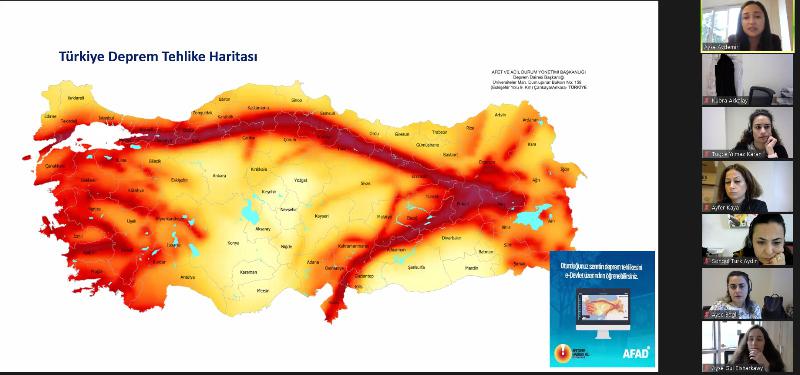
"Earthquakes cannot be prevented, but their transformation into a disaster can be"
Providing information about earthquakes, Lecturer Aydemir said; "The world is made up of puzzle pieces, and we call these puzzle pieces plates. These plates are constantly in motion. As a result of these movements, faults occur. Energy accumulates in these faults. Earthquakes occur by shaking the earth's surface in waves. Earthquakes are natural phenomena whose occurrence cannot be prevented. They are natural events we cannot stop. It is impossible to predict when, where, or of what magnitude an earthquake will occur. We cannot prevent earthquakes, but at least their transformation into a disaster can be prevented. This can be done through a preparation process. By raising awareness, providing training, conducting drills, preparing disaster kits, and making buildings robust, we can manage this situation more consciously."
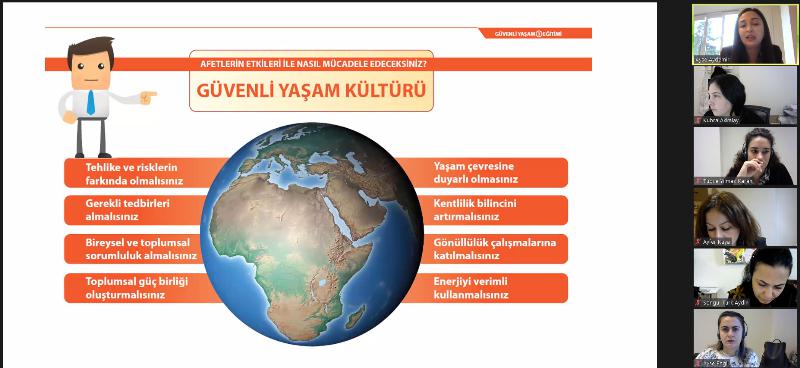
"Earthquake intensity and earthquake magnitude are different concepts"
Stating that earthquake intensity and earthquake magnitude are different concepts, Lecturer Aydemir said; "Earthquake intensity and earthquake magnitude are different concepts. Earthquake magnitude is entirely the value you find with a seismograph, that is, the device that measures the earthquake. The value obtained as a result of a purely mathematical calculation, a formula, is expressed as the earthquake's magnitude. Earthquake intensity, on the other hand, refers to the extent to which the earthquake affects buildings. How many buildings were destroyed, the number of severely and moderately damaged buildings, and to what extent people were affected. If it refers to the concept of impact, it is expressed as earthquake intensity. While the concept of magnitude is an omnipresent, objective indicator, earthquake intensity is a concept that varies according to individuals and their location."
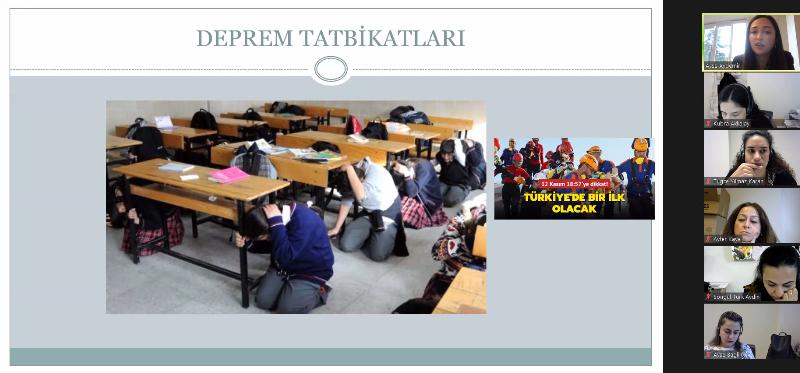
"It should be made a reflex by continuously conducting drills"
Aydemir, referring to what we need to do before, during, and after an earthquake, said; "Before an earthquake, the first thing is to learn emergency numbers and teach them to those around us. One of the most important measures to be taken before a disaster is to prepare a disaster kit. Items such as hygiene materials, a flashlight, spare batteries and a radio, water and food, long-lasting foods like canned goods, long-term medications, seasonal clothing, and some cash should be put into the disaster kit. It is important that the disaster kit is easily accessible. Before a disaster, assembly points can be accessed via E-Devlet. Importance should be given to drills in this regard. The robustness of the building is the most important factor that will save us. We need to remain calm during an earthquake. By continuously conducting drills and turning it into a reflex, we will actually learn to remain calm. After an earthquake, without panicking, we should check those next to us for injuries and try to move. He also stated that phones should not be unnecessarily tied up."
Share
Update Date: February 26, 2026
Creation Date: November 28, 2022
Request a Call
Other News
- Prof. Nevzat Tarhan: “Every segment of society should be able to say, ‘This constitution is my constitution!’”
- OHS Releases Guide for Safe Operation of Industrial Robots
- Prof. Nevzat Tarhan: “Social media is digital fast food”
- 2026-2027 Academic Year orientations completed
- Asst. Prof. İdil Arasan Doğan explained the importance of early intervention in living with dementia