

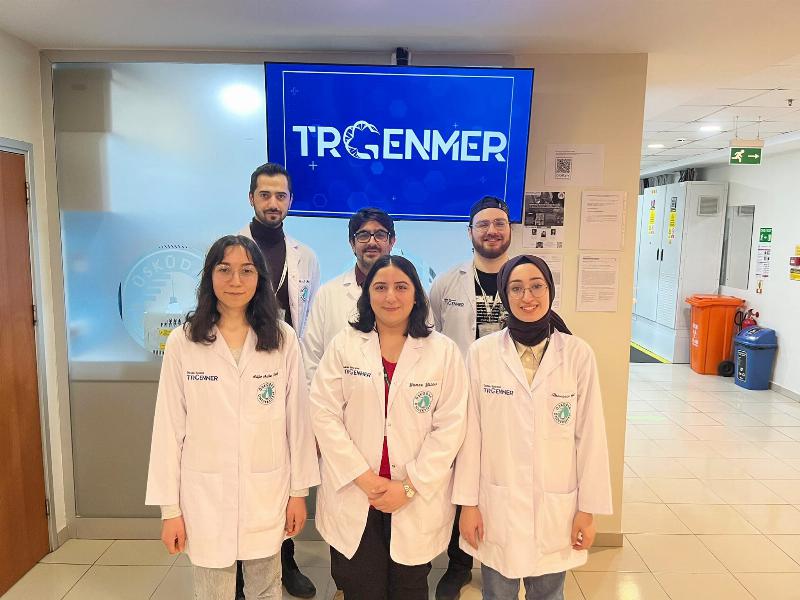
The Üsküdar TRGENMER team, which continues its work with the goal of creating a patient potential free of cancer for many years by recognizing and killing cancer with the CAR-T cell therapy they developed against cancer, as well as increasing memory cell potential, is getting closer to its goals step by step. Now, the in vitro laboratory studies of CAR-T cell therapy have been published in the SCI-indexed Vaccines journal's special CAR-T cell issue. The 'ALLBiMEM' brand registration has also been completed for the Üsküdar product, which produces CAR-T cells domestically in Turkey.
Content
CAR-T cell therapy featured in Vaccines journal's special CAR-T cell issue
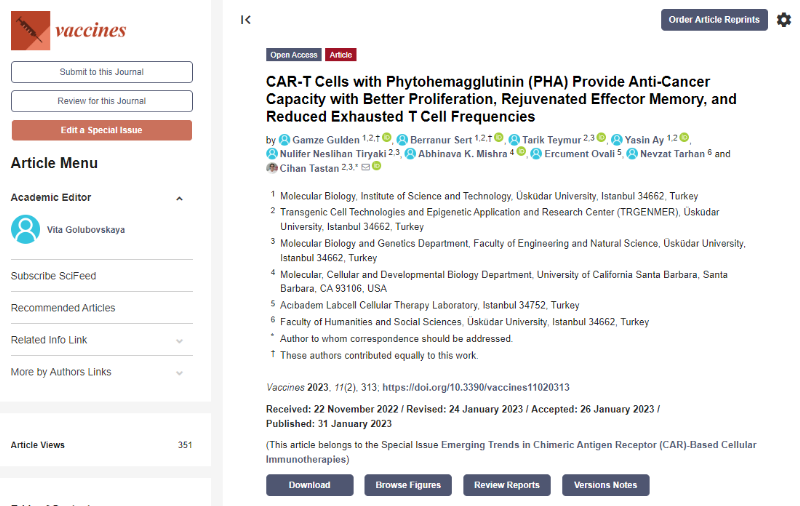
The in vitro laboratory studies of transgenic CAR-T cell therapy, which is being developed against Acute Lymphoblastic Leukemia (ALL) cancer and supported by the Turkish Health Institutes Presidency (TÜSEB) in the field of Cancer Immunotherapy from the opening of the TRGENMER center during the July 2021 - July 2023 period, have been published in the SCI-indexed Vaccines journal's special CAR-T cell issue.
“It raises the hope that the patient can be completely cured of cancer”
Dr. Cihan Taştan, Faculty Member at Üsküdar Üniversitesi, Faculty of Engineering and Natural Sciences, Department of Molecular Biology and Genetics, provided information about CAR-T cell therapy.
Taştan stated that they aim to create a patient potential free of cancer for many years by increasing memory cell potential; “The CAR-T cell therapy we developed against cancer is personalized and has the ability to recognize and kill cancer. Compared to classical cancer treatments, it has the potential to kill all of a patient's cancer at once due to its more specific, targeted killing. This raises the hope that the patient can be completely cured of cancer. With this project, we can normally produce killer cells and we know that we can clearly kill cancer. When administering these cells to the patient, we made sure they are both killer and memory cells. Thus, after completely eradicating cancer from the patient in the initial stages, we aim to create a patient potential free of cancer for many years by increasing the memory cell potential to prevent the patient from needing treatment again in the future.”
“We are trying to train researchers from the ground up”
Taştan emphasized that all studies carried out within the scope of the article were conducted by researchers at Üsküdar Üniversitesi TRGENMER center; “All studies we conducted within the scope of our article are carried out by our researchers at our Üsküdar Üniversitesi TRGENMER center. Gamze Gülden, Berranur Sert, Yasin Ay, and Nilüfer Neslihan Tiryaki are our researchers pursuing Master's degrees in our Molecular Biology department. Tarık Teymur is our final-year undergraduate student in the Molecular Biology and Genetics department. At our TRGENMER center, we strive to meet our country's need for expert researchers by identifying and training our high-quality and successful students from their undergraduate years, right from the beginning.”
“We will enter a period where the drugs we call CAR-T cells can be used”
Dr. Cihan Taştan, Faculty Member, mentioned that the preparations for the third phase clinical trial studies are planned to start from July 2023; “Currently, our transgenic mouse studies, where we established the ALL cancer model, are continuing until July. We are planning the preparations for our third-phase clinical trial studies to start from July 2023. Our researchers in this project will also complete their GCP and GMP certificate trainings within this scope and support clinical production. We will enter a period where Turkey can use smart living drugs, which are what we call CAR-T cells, for certain types of cancer by entering clinical phases.”
Prof. Dr. Nevzat Tarhan is also an author in the article…
Taştan noted that Üsküdar Üniversitesi Founding Rector Prof. Dr. Nevzat Tarhan is also an author in the article; “Our Founding Rector, Prof. Dr. Nevzat Tarhan, who has enabled us to produce rare and world-standard studies and products at Üsküdar Üniversitesi, is also present as an author in our article. I also owe a debt of gratitude to Dr. Abhinava K. Mishra from the University of California, Santa Barbara, and Acıbadem Labcell Laboratory Director Prof. Dr. Ercüment Ovalı.”
Click here to read the full article:
Share
Update Date: March 01, 2026
Creation Date: February 02, 2023
Request a Call
Other News
- Experts warn: 'Instead of memorizing letters, teach pencil grip, scissor use, and coloring'
- School fear and school love both start in the family!
- Family is not merely transforming, it is being battered under a serious assault
- Artificial intelligence opens the door to early diagnosis in autism!
- Artificial intelligence doesn't end engineering, it transforms it!