

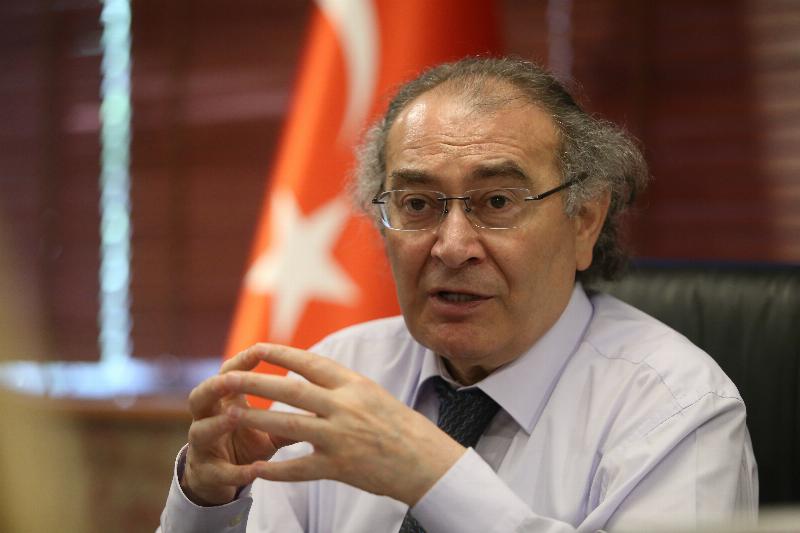
Üsküdar Üniversitesi Founding Rector Psychiatrist Prof. Dr. Nevzat Tarhan addressed the topic of “Autism” in his Hürriyet Aile column this week.
Content
Attention to babies unable to form emotional bonds!
The prevalence of autism, a neurodevelopmental classified disease, is increasing. Currently, it is stated that one in 68 newborns is autistic. The reasons for this increase are being investigated worldwide. Early intervention in autism is of great importance. Especially, the child needs to be well observed. Humans, being social beings, start social interaction from birth. There must be an emotional transfer between mother and baby. This transfer does not occur in autistic babies. Especially between 0-3 years of age, the use of technology needs to be prevented.
Autism, a neurodevelopmental classified disease defined in childhood, begins in very early childhood, and if diagnosed during childhood, the treatment of the disease becomes easier. The most important characteristic of autism is its onset in childhood and early childhood. If the same characteristic appears in later periods, it is defined as psychosis, not autism.
The most important symptom of autism…
One of the most important symptoms of autism is inadequacy in social communication and interaction. In autistic children, this symptom can be understood almost from birth, even before the child starts walking. There is inadequacy in the child's social communication and interaction. A 6-month-old baby should babble, and a 9-month-old baby should make sounds like ‘ga… ga’. A 15-month-old baby should use two-syllable words. Autistic babies and children cannot do these, or they do them late. In social communication, they don't want to be held. Even if held, they can react excessively; there is such an inadequacy in social communication and interaction.
Social interaction begins from birth
Humans are relational beings. Autism is essentially a disorder in forming relationships with people around them. Social interaction begins from birth. Humans are not mentally coded to live alone. They absolutely need to form relationships. When a baby is born, their first reaction is crying. Why crying? They have come out of their mother's womb, their comfortable environment. Cold air suddenly enters their lungs. Their body comes into contact with cold. They get scared, they cry. When they cry, they need someone to take refuge in, they hug their mother, and their mother's scent calms them. Even if hungry, their first need is the need to bond with their mother.
Autism means being unable to use emotions
In autistic children, this bonding does not develop sufficiently. In fact, in advanced autistic individuals, even the concept of 'mother' does not develop. For these individuals, there is only a caregiver. There is no exchange of love. Autism, in essence, is being unable to use the feeling of love. It means being unable to use emotions. Autistic children and individuals have deficiencies in establishing, maintaining, and understanding relationships. Autism is said to be a kind of introversion disease. These children or individuals choose, prefer, and like to be alone.
Beware of limited repetitive behaviors!
Other main group symptoms in autism are limited repetitive behaviors. These children constantly rotate objects like plates or toys they hold in their hands. They engage in such behaviors without verbal communication or watch rotating devices like washing machines for hours. There is an excessive attachment to routine things. Especially, repetitive behavior sometimes becomes such that the child becomes excessively attached to something they are accustomed to in their environment. When it is changed, the child reacts excessively.
An increase in autism is observed
Globally, there is an increase in autism. In the years we were students, autism was said to be 2-3 cases per 1000. Now it is stated to be 10 per 1000, which means 1 percent. In fact, today it is stated that one in 68 newborns is autistic. This means 1 in 68, implying that this rate even exceeds 1 percent. The reasons for this increase are being investigated worldwide.
Should be kept away from screens during the 0-3 age period
During the 0-3 age period, children should absolutely not be given tablets or mobile phones. Mothers generally use these devices to feed children. After a while, the child starts to be unable to do without them. Digitalization and the digital age are considered one of the very serious risks in autism. It leads to social isolation in children.
Beware of delayed speech!
With developing technology, it is noteworthy that symptoms resembling autism appear in children who come into contact with smart devices. These children become like autistic children; we call this 'learned autism'. They come with complaints of delayed speech. The child is 4 years old and still cannot speak. We see that there is a television at home, which we call a 'cheap babysitter'. The mother has given the child a tablet and is busy with housework all day. The child plays with the tablet, and the child's word production skill does not develop. What happens when it doesn't develop? There is no one speaking in front of them, they cannot receive mental stimulation. One-sided imitative behavior emerges. Because they cannot produce words, the brain becomes lazy. For a period, this situation was called 'clip syndrome'. When the television or tablet is removed, the child learns to speak in a short time.
Early diagnosis is important in autism
Early intervention is important in autism. The most commonly detected symptom in autism is delayed speech, around 4 years of age. By then, it's too late. If autism is detected at 1 year old and measures are taken immediately, recovery is much faster and easier. Especially mothers who become pregnant at an older age should pay attention to some symptoms. A child laughs in their dreams as soon as they are born, but this is not observed in autistic children. When the baby sees the mother, they laugh, rejoice, and play. There must be an emotional transfer between mother and baby. This transfer does not occur in autistic babies.
Theory of mind is taught in new generation therapies
Autistic children have undeveloped empathy. If you gather 1-year-old autistic children in a room, when one cries, they all cry. Why do they cry? Because their empathy has not yet developed. But they mistake someone else's crying for their own crying. The brain mirrors. They also start crying. In children of this group, crying becomes contagious. Because the brain has not learned the distinction between 'their pain' and 'my pain'. This is called theory of mind. This exists only in human children. The ability to guess what is going on in someone else's mind does not exist in animals; it is unique to humans. The brains of autistic children cannot do this. With new treatment methods, children are taught theory of mind. One should not think that autism cannot be treated. If detected early, they learn while playing with other children. Social contact is the best and most important method for correcting autism. Therefore, if a child does not have siblings or friends, they should definitely be sent to a nursery school after the age of 3. Even attending for half a day in a nursery environment is important. For this reason, apartment children carry these risks.
New generation treatment methods are being used
New methods are also being used in the treatment of autism. One of the new treatments is sensory integration therapy. Previously, 4 senses were measured in autistic individuals: fine motor, gross motor skills, sensory skills, and social skills. Now emotional skills are also being measured. After identifying the brain areas responsible for emotions, the goal is to develop emotional skills, understanding the emotions of the other party, recognizing one's own emotions, and being able to use them. Neuromodulation therapies are being used. Brain cell stimulation (TMS=Transcranial Magnetic Stimulation) methods are being employed. The child's development accelerates significantly. The child's mental development, behavioral development, and social interaction are positively affected. The child can be held and can play with friends.
Share
Update Date: March 01, 2026
Creation Date: August 02, 2022
Request a Call
Other News
- The book that read today's digital threats in 2014: Being a Conscious Family
- Experts warn: 'Instead of memorizing letters, teach pencil grip, scissor use, and coloring'
- School fear and school love both start in the family!
- Family is not merely transforming, it is being battered under a serious assault
- Artificial intelligence opens the door to early diagnosis in autism!